Monday, 14 April 2014

Fentons part of Slater & Gordon: Will I , Won’t I? - The Importance of Making a Will


I just wanted to share with you something very tragic that happened recently.

One of our clients, whose claim for personal injuries sustained in an accident a few years ago and which settled at the end of last year, has sadly died suddenly.

He had sustained a spinal cord injury many years previously and the recent injuries had only served to make life that bit more difficult for him. The monies recovered through the claim were to assist in improving his quality of life and cover the cost of the additional care and equipment he was going to need in the future.

Our client was divorced but still on amicable terms with his ex-wife who was still involved in his day to day care. He had a daughter who he had not seen for many years and with whom he had no relationship.

During and at the end of the claim, it was suggested to our client that he make a will so that his estate would pass in accordance with his wishes in the event of his death. Unfortunately this never happened and he died intestate.

As his next of kin, his daughter now stands to inherit everything, including his house and the damages recovered from his claim, something which our client would not have wanted.

The importance of making a will cannot be underestimated. For very little cost, it ensures that provision is made for loved ones and monies and assets pass in line with the wishes of the person who has died.

Why let the law make this decision for you? Make a will now – before it’s too late.

For more information, please get in touch.

Deborah Johnson – Fentons Solicitors (part of Slater and Gordon Lawyers)
Principal Lawyer – Serious and Fatal Incidents
National Manager (Client Support Organisations) and National Practice Development Leader (Road Collision)
Telephone – 0844 854 3103

Wednesday, 9 April 2014

Planning for the unexpected: A Lasting Power of Attorney


A Lasting Power of Attorney (LPA) is a legal document which allows you to appoint somebody else, or more than one person (the attorneys) to make decisions on your behalf regarding property and affairs or your Health and Welfare. These are two separate documents so you can have either one or both types of LPA. A LPA is usually used if you lose the ability to make your own decisions (capacity). However an LPA can be used, with your permission, even if you can make your own decisions. This means that if you are having a long stay in hospital you can appoint an attorney to deal with your affairs on a temporary basis.

A Heath and Welfare LPA allows you to appoint an attorney or attorneys to make decisions about your Health and Welfare if you are unable to make the decisions yourself. The decisions can include life sustaining treatment, care regime and diet. Specific permission needs to be given in respect of life sustaining treatment. An attorney can only act under a Health & Welfare LPA if you lose the ability to make your own decisions and the form has been registered with the Office of the Public Guardian.

One of the main advantages of an LPA is that it is prepared while you still have capacity so you can decide who you want to be your attorney or attorneys. You can also put restrictions on the LPA clarifying or limiting the attorney’s powers to act. This means that you can plan ahead for a time when you may be unable to deal with your affairs. Your attorney is also answerable to the Office of the Public Guardian and can be prosecuted if they do not act in your best interests

If the worse should happen and you find you lack capacity either due to dementia, an accident or medical complication it is much easier for your attorneys to act quickly if an LPA has been done. If there is no LPA any potential attorney will need to make an application to the Court of Protection to be appointed as your Deputy. This can be quite a long winded process, it is expensive and you will not have any control over who your Deputy is. In respect of a Health and Welfare LPA it is reassuring to know that if a decision has to be made and you cannot provide consent the parameters of any decisions an attorney can make has already been clearly considered at a time when you can carefully decide what powers you wish to give an attorney.

Katie Pendower Fentons Solicitors part of Slater & Gordon Telephone number 0844 854 3198

Friday, 28 March 2014

Fentons part of Slater and Gordon Ruby Partners for April

Fentons part of Slater and Gordon are delighted to be supporting SIA during their 40th anniversary year.

Come back throughout April as we will be discussing some important topics and give you the opportunity to ask us questions.

Monday, 24 February 2014

Helping Hands: Local Care Service Manager Clare Turner


I am the local care service manager for East Anglia and while I don’t currently have a customer with a spinal injury, this time last year my fiancé broke C7 which as you know is in the neck and was paralyzed for 2 weeks. 


Following surgery to remove it, and replace it with a steel scaffold and screws it has been a long road of physio and support from Addenbrooks hospital and Stoke Mandeville spinal unit as an outpatient. Despite working in health and social care for 25 yrs, being a relative of someone who is told they have a 50/50 chance of never walking again is a heart stopping moment in time. He was lucky and has made a good recovery but it has given me a very different outlook on life and also the work I do at Helping Hands.


For more information please call 0808 180 1553.


Friday, 21 February 2014

Helping Hands: Why is quality of care so important when dealing with people who have spinal injuries? By Abbey Herbert (Senior Quality Assurance Manager)


Quality of care and dedication to excellence are essential elements to ensure the most successful outcomes in spinal injury customer care and satisfaction.

Helping Hands’ carers are dedicated to provide the very best care to maintain its lead in the treatment and care of people with spinal injuries. To facilitate this we are committed to developing the skills and potential of all our staff. Our aim is to develop a workforce which has inquiring minds and is capable of learning from customers as well as colleagues. Our teams challenge and change practice in order to improve and develop the care they give.
Excellence in spinal injury care is facilitated by providing access to specific complex care training. 

The support we provide at Helping Hands should enable people with spinal injury to:

1. Have confidence that the care they receive will be of a consistent high quality

2. Control their own care and feel confident working in collaboration with the carer.

3. Know that their care has been designed in a way that acknowledges its place within their broader lives.

Our services at Helping Hands concentrates on understanding and meeting individual, practical and social needs of people with spinal injuries who wish to live independent lives in their own homes.  For more information about spinal injury care quality, please contact Abbey Herbert on 0808 180 1553 or visit www.helpinghandshomecare.co.uk/spinal-injury.aspx


Monday, 17 February 2014

Helping Hands: Simon and Anna's story


Spending an afternoon with Simon Brain and Anna Chmielewska, one of our long-term live-in care partnerships, it is clear to see why we do what we do. Simon, who previously sustained a C5/C6 spinal cord injury at the age of nineteen, has been receiving live-in care from Helping Hands since 2000. 

Immediately after sustaining his injury, Simon was understandably anxious. An independent young man, he was unsure about what the future would hold and how the direction of his life would change. 

“For the first few years after my accident, I closed myself off and didn’t want to do anything as I was originally worried what other people would think. However, over time I started going out to different places and stopped worrying about what other people thought.”

Receiving Live-in Care from Helping Hands, although later proving a great decision, was initially a daunting prospect that contributed to Simon’s uncertainty. 

“It was a shock,” Simon explains. “Going from being so independent to relying on someone and putting your trust in them was difficult. In the beginning, I was instructed to stay in bed because of an unhealed pressure sore. I was advised to stay in hospital, but I just wanted to get home. Helping Hands came out to me, and I was able to return home with support from one of their Live-in Carers.”

Now, fourteen years down the line, Simon is embracing independent living with support from his permanent Helping Hands Live-in Carer, Anna Chmielewska. Visiting them at home, it is clear to see that they are a perfect match.  

“When a Carer first arrives, I am a little bit nervous about whether or not we will get on. I prefer Carers to be a similar age to me, as then we generally have a similar taste in music and films. My permanent Carer, Anna, is just great.”

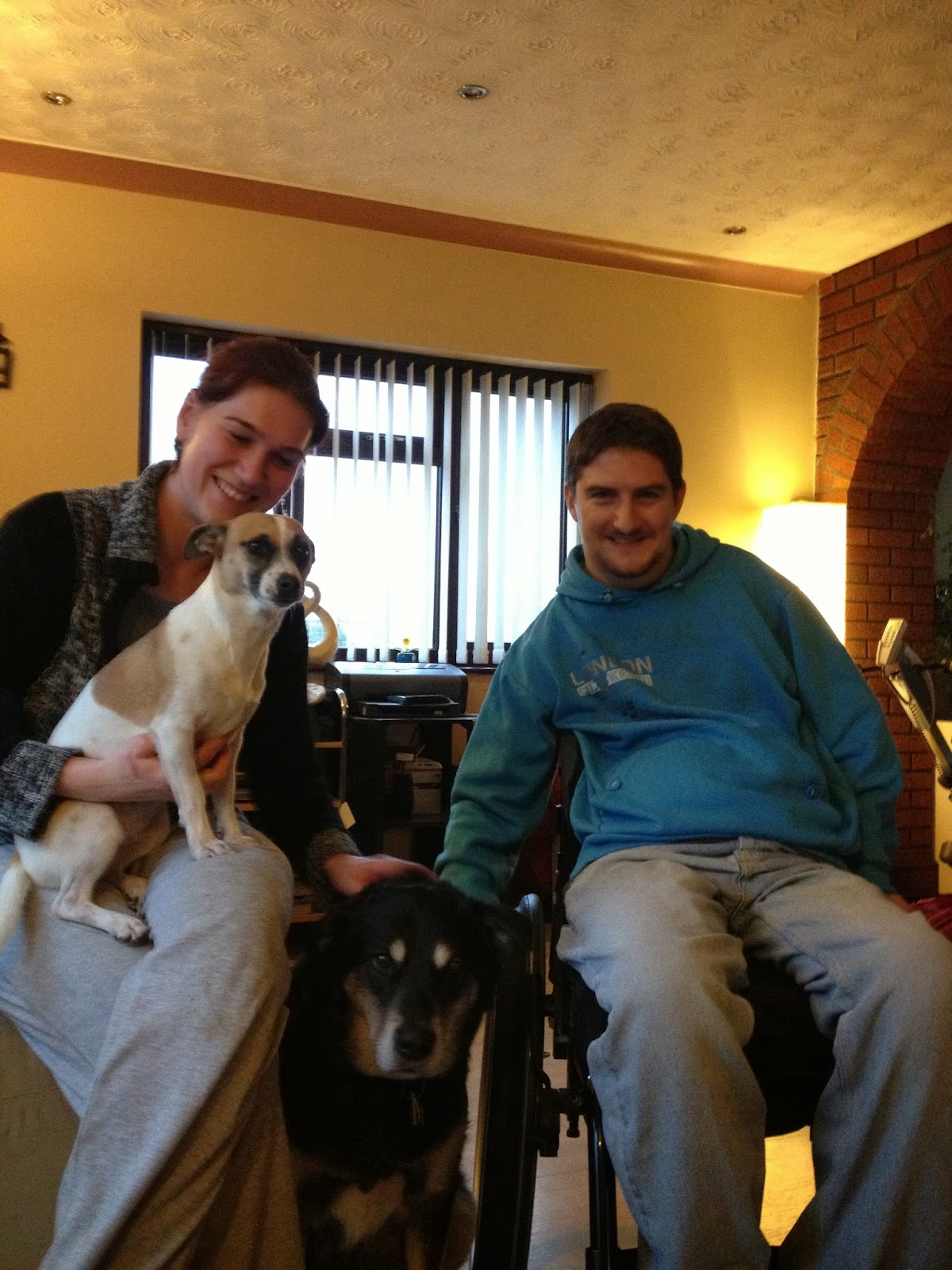
Sitting together in front of a roaring open fire, Anna brings in Simon’s two dogs, which are obviously spoilt rotten by the pair. United by their love of dogs, Anna and Simon just seem to click, and it is clear to see that Helping Hands’ matching process worked perfectly for them.
“You really can’t fault the Carers,” Simon remarks. “The matching process is great and Anna is perfect in terms of personality and competence.”

Every day, Simon and Anna work well together. They maintain a routine that follows the outcomes stipulated in his individualised plan of support, whilst having fun along the way.
“We generally stick to the same morning routine,” says Simon. “Anna supports me in the morning with my personal care routine. Then, in the afternoon, I spend my time studying web design and photography on the computer. Being a self-employed photographer is definitely an option for the future.”

With support from Anna, Simon continues to pursue his chosen lifestyle. Here at Helping Hands, we are committed to making independent living possible for many others like Simon across the UK. 

Offering invaluable advice to others affected by spinal cord injuries, Simon says, “When I was in hospital, being around other people with spinal cord injuries and seeing how confident they were taught me to move forwards. 

I would say to others in my position, just get back out there and start living your life. Before my accident, I was really active and into sports. I couldn’t see myself doing anything with computers, but you just have to work through it and try different things.”

Leaving Simon and Anna to it, we know that we have just witnessed what Live-in Care is all about. 

 If you, like Simon, have sustained a spinal cord injury and would like support from someone like Anna, please contact Helping Hands today on 0808 180 1553.